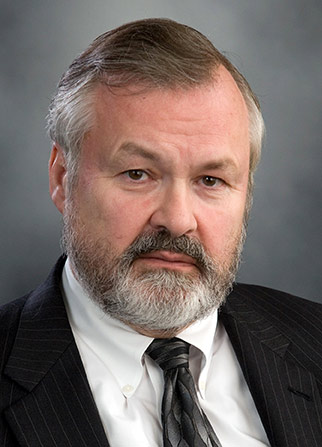
In March 2002, George Halvorson was named Chairman and CEO of Kaiser Permanente, the nation’s largest nonprofit health plan and hospital system, with nearly 8.9 million members. Having 30 years experience in health care management, Halvorson is also the author of several books, including Health Care Will Not Reform Itself. Among his accomplishments is the successful rollout of Kaiser’s multi-billion dollar information technology initiative, which he describes here. He took time from his busy schedule to join LATINO Editor Alfredo Estrada in our CEO Forum.
Let’s begin with the subject of diversity. What does it mean at Kaiser Permanente?
We are one of the most diverse organizations in the country...[and]we were doing diversity before diversity was cool. Rosie the Riveter worked for [company founder] Henry Kaiser. Kaiser’s shipyard was the first to hire women. Our sense of inclusion at Kaiser Permanente goes back to our founder. When he built his first hospital in Oakland [in 1945] some of the city fathers suggested that the hospital had to have segregated wings. Kaiser turned to the doctor and asked if there was any biological reason to split care by race. The doctor said none whatsoever. Kaiser then said, “That’s it, it’s over. There’s no reason to do it and we’re not going to do it.” I inherited a proud tradition of embracing and celebrating diversity at Kaiser Permanente.
What’s the impact of this tradition on the corporate culture?
It creates synergy, it creates opportunity. Someone on the front lines at Kaiser Permanente knows that there is no glass ceiling, no barrier to promotions, and that we are a meritocracy. And what you get in a meritocracy is high performance. In an inclusive meritocracy, people perform at a very high level and that’s what we have. It also creates a commitment to the members. ...We’re people helping people. And that creates an attitude toward service and care that’s very inclusive. We take great pride in our diversity and we try very hard to reflect the needs of a diverse patient population.
How does embracing diversity help your bottom line?
We get to hire the best people. People look at us and think if I go there, I’m likely to be promoted, and respected, and have an opportunity to grow in my job. And so hiring is easier. When our people are recruiting, if you point to the success we’ve had a diverse organization, that’s a plus. ... Another issue is we live in very diverse populations. We’re in Hawaii, Washington, DC, San Francisco, Denver, Cleveland, Atlanta, Los Angeles, and other very diverse cities. When people in those communities look at us, they have the sense that Kaiser Permanente represents the diversity in those communities. And that’s good for growth.
Please tell us about your upcoming 34th annual diversity conference.
Each year, we have a diversity conference where we bring together hundreds of caregivers who talk about the challenges of serving a diverse population. ...Both caregivers and the population they serve are diverse, which creates a level of expertise you wouldn’t find in another setting. It’s not us and them. We’re all us at Kaiser Permanente. This year’s theme is “Ending Disparity.” One of the things we do is track care delivery by race and ethnicity. So upper management knows how we’re doing for each care site. We know that there are consistent differences, so our goal is to narrow these differences and continuously improve across all populations.
You’ve written extensively about the role of technology. How does it affect health care?
Health care is an information dependent science that has typically very weak access to information. Most patient information is on paper medical records. They’re inaccessible, inert, sometimes illegible. So we’ve created the largest electronic medical record system in the world. We’ve invested a total of $4 billion in computerizing our support so doctors can have the right information about patient in real time at the point of care. Our basic philosophy is all,all, all. That means all the information for all of our patients all of the time. Because of that, doctors can do really good work. It’s one of the resons we’re winning all the awards for best care.
That makes sense. But how does having all this information help
health care delivery?
In this country, 80% of patients are treated by more than one doctor. And most of the time, if you have more than one doctor caring for a patient, they don’t know what the other is doing. they don’t know what prescriptione were given, they don’t know what care is being given, they don’t know what surgeries are being scheduled or have been performed. Information is so badly shared that doctors are flying blind all the time. Our approach is never to have the doctors flying blind and always to have the information about patients in real time. We want to know if one prescription will create a negative complication with another prescription---we can do that electronically. And when the doctor writes the prescription, the computer tells him that the patient is also taking this other drug. ...And if you’re a Kaiser Pemanente member you can pull up your medical records from the internet anywhere in the world. Your doctors can communicate with each other electronically, sharing the same information about a patient, so they can make better decisions.
Has this transformation happened in the entire health care industry?
We’re the cutting edge. We are teaching the rest of the world how to do this. We’re also teaching the rest of the world to use complete information about each patient because no one else has it. Other people would do what we’re doing if they had the information but they don’t. Isolation is the rule rather than the exception. We’ve only had it at his level for a very short time, so there’s a great learning curve. It’s only been a couple of years, and it took about four years to get it up and running. We’re a very large organization. ...
Many companies have Latino employee groups. What is the role of these organizations at Kaiser Permanente?
Different organizations have different philosophies about [employee] affinity groups. We believe that the role of affinity groups is to teach and share, to be inclusive relative to other groups, being a voice for the community inside KP, identifying rising leaders, and being our radar for issues we need to address. We need people to understand each other, and we need people to relate to each other and share values. So part of the opportunity is how can we explain what our values are. It becomes a vehicle for shared learning as much as for spending time together. We want to better understand the broader issues in the overall population.







 CEO Forum